
I looked into the toilet and did a double-take. What I saw didn’t look like anything I’d ever seen my body expel. It looked like a rope—long, tubular, almost structured— worm-like.
This wasn’t random; it came after taking Mimosa pudica, a botanical used in gut-cleansing protocols. The seeds form a sticky, gelatinous substance in the digestive tract, binding to mucus, biofilm, and debris and pulling it out as one cohesive mass.
When I spoke to my friend, author, journalist, and coach Dani Katz, who has been doing an intense parasite cleanse, she told me she had seen them in her poop, too. Meanwhile, during an interview with Brian Richards of Sauna Space two years ago, he told me he had also seen them.
The thing is, they look a bit synthetic. And given that the Internet poo-pooes the possibility of genetically modified parasites and dubs them conspiratorial, Dani and I agreed there was more to the story!
Repeating Patterns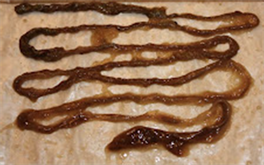
Across colonics clinics, Reddit threads, Telegram detox groups, and practitioner anecdotes, the descriptions line up with eerie consistency:
- Long, rope-like structures
- Sometimes exceeding a foot
- Often emerging after enemas (especially coffee enemas)
- Recurring during parasite cleanses or binder protocols
I observed 10 characteristics:
1. “It looked manufactured.”
“I passed something that looked like a long piece of rubber tubing. It wasn’t soft like stool—it had structure. When I tried to break it, it stretched before snapping. I’ve never seen anything like it come out of my body.”
This “synthetic” description comes up a lot. Why is it that people sense it’s not natural?
2. “It came out during a coffee enema and kept coming.”
“I was doing a coffee enema and something started coming out that just kept going. It wasn’t one piece—it was like a rope that didn’t end. I actually got scared and stopped midway.”
Length and continuity are recurring themes—people expect waste, not something that feels like an endless scarf trick.
3. “It had a smell that didn’t match anything I’ve experienced.”
“The smell was completely different from normal bowel movements. Foul. Almost chemical or metallic. That’s what made me think it wasn’t just food or waste.”
In my recent interview on Truth Lives Here, Dani and Brian remarked on the foul smell
4. “It didn’t break apart in water. ”
“I flushed and it didn’t dissolve or fall apart like normal stool. It held its shape. I even poked it because I couldn’t believe it—it felt cohesive, like one piece.”
Durability and cohesion are key—people expect disintegration.
5. “It seems to have different stages.”
“At first, I thought it was nothing—just mucus. Then it came back. And again. Each time, it looked more organized. What started as loose strands turned into something longer, more cohesive—until one day it came out as a full rope-like piece. That’s when it stopped being easy to explain away.”
All three of us also observed seeing different phases. I’ve seen cloudy, gelatinous strands that look like ordinary mucus. Then, with repeated protocols—enemas, binders, Mimosa pudica—it becomes more defined, forming short, rope-like fragments. Then there are the better-formed tubular pieces, sometimes twisted or braided.
6. “It looked twisted—like it had been spun.”
“It wasn’t just straight—it looked twisted, almost braided. Like something had shaped it that way.”
Organic material isn’t expected to look engineered.
7. “I thought it was intestinal lining… until I saw it again.”
“The first time I assumed it was lining. But then it kept happening, and it looked the same every time. That’s when I started questioning it.”
Repetition is what converts skepticism into curiosity.
8. “It felt like something was attached before it released.”
“It didn’t feel like a normal bowel movement. There was resistance—like something wasn’t ready to let go. And then, all at once, it released.”
It’s a strange detail, but it comes up often enough to note. The sensation isn’t necessarily evidence of anything “alive,” but it does point to a different physical experience—one where the material moves as a cohesive mass, creating a momentary resistance before detachment. What people interpret as something “holding on” may be the body dealing with adhesion, pressure, and release—but the feeling itself is real, and distinctly different from anything they’ve experienced before.
Both Dani and I have experienced sitting on the toilet, knowing you need to have a bowel movement, but it comes out on its own schedule.
9. “It only happens when I do certain protocols.”
“I never see this unless I’m doing enemas or taking binders. If I stop, it stops. When I restart, it comes back.”
That conditional appearance is one of the most consistent data points. I concur.
10. “It didn’t look alive—but it didn’t look inert either.”
“It wasn’t moving. But it didn’t look like waste. It had shape—defined, continuous, almost intentional. Like it had been formed, not just passed.” claiming it’s alive, but they acknowledge it doesn’t resemble anything they’ve been conditioned to expect from the body. It has structure. It looks organized. And it doesn’t feel entirely dead.
So What Is It?
In 2013, a paper began circulating online: “Development stages of the ‘rope’ human intestinal parasite by Alex Volinsky et al. You can read it here. On its face, it read like a discovery. The authors described a previously unknown organism—an anaerobic organism living in the gastrointestinal tract, capable of growing to over a meter in length, attaching to intestinal walls, and being expelled during enemas. They even outlined five stages, beginning as mucus-like material and progressing into fully formed rope-like structures.
But here’s the problem: it wasn’t published in a journal. It was uploaded to arXiv, a preprint server. No peer review. No replication. No institutional backing. So that made it easy for the medical establishment to dismiss it outright. Convenient!
And when similar samples were actually analyzed, the results were blunt. Roughly 99% human DNA. What is the 1 percent, though? Mainstream medicine doesn’t recognize “rope worms” as parasites. They lump it in with things like mucoid plaque—non-pathological, misinterpreted, case closed.
Except it’s not that simple.
The official explanation, while technically sound, doesn’t fully resolve what people are actually experiencing. If this is just mucus, tissue, fiber—fine. Then explain why it forms coherent, rope-like structures. Explain why it holds together outside the body. Explain why it shows up repeatedly under specific conditions—especially during enemas, cleanses, or protocols involving binders or botanicals like Mimosa pudica. That’s where the explanation starts to feel incomplete.
The mechanical model goes like this: you irritate the gut; the body produces more mucus as a protective response; binders create cohesion; and peristalsis shapes the material into tubular forms. But the consistency of what people are describing is BIZARRO.
Genetically Modified Rope Worms?
Brian and Dani didn’t dance around it. They said outright: what people are seeing could be tied to genetically modified parasites—something emerging from altered yeast strains and the synthetic inputs fed into livestock and pushed through the food chain. And many people have the same instinct: this isn’t just mucus. This is something that looks engineered—something that doesn’t behave like anything the body naturally produces.
That thread runs deep in detox forums and alternative health communities. People connect what they’re seeing to processed food, chemical exposure, and a gut environment that’s no longer organic, but altered. Not subtly—systemically.
And yeast has already been modified. Saccharomyces cerevisiae has been engineered for decades and is widely used across food production, pharmaceuticals, and biotechnology.
So the question isn’t crazy—it’s actually the only logical next question: if modified yeast and microbial fragments are entering the body consistently, what are they doing inside a compromised gut? Are they interacting with mucus layers, biofilms, or existing microbial ecosystems in ways we haven’t mapped? Could they be contributing to structured, cohesive material that doesn’t resemble normal waste?
That’s the hypothesis. But of course, there is no funding for a serious investigation. And when you understand who has historically shaped medical narratives, it’s not unreasonable to ask whether certain lines of inquiry simply never get pursued.
RESOURCES:
- Get An Infrarered Sauna Space Panel (Discount code: HONEYCOLONY)
- Interview with Brian Richards and Dani Katz on Truth Lives Here
- How Coffee Enemas Helped Save My Life!
- Happy Bum Coffee Enema Kit W/ Organic Medium Roast